Hydroquinone: without sunscreen it is wasted
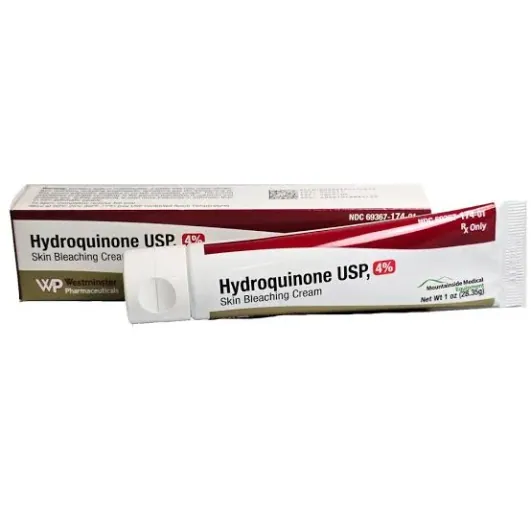
| Product | Dosage | Quantity | Price | Order |
|---|---|---|---|---|
| Hydroquinone | 4 %mg | 1 tube | £37.78 £34.00 −10% | |
| Hydroquinone | 4 %mg | 2 tube | £61.11 £55.00 −10% | |
| Hydroquinone | 4 %mg | 3 tube | £68.89 £62.00 −10% | |
| Hydroquinone | 4 %mg | 4 tube | £75.56 £68.00 −10% | |
| Hydroquinone | 4 %mg | 5 tube | £83.33 £75.00 −10% |
Where does pigment come from?
Specialised cells in the skin called melanocytes produce melanin, and an enzyme called tyrosinase controls the critical step in making it.
When those cells are overstimulated — by sunlight, by inflammation, by hormones — they produce more pigment than the surrounding skin and a patch appears.
Hydroquinone inhibits tyrosinase.
Less pigment gets made. The patch does not vanish, but as the skin renews over weeks the darker cells are replaced by less pigmented ones and the contrast fades.
What does it work on?
- Melasma, the hormonally driven patches often appearing in pregnancy or with contraception
- Marks left behind after acne or inflammation
- Sun-related age spots
- Uneven tone
It works best on recent, superficial pigmentation. Deeper, long-standing pigment responds more slowly and less completly.
Why is sunscreen half the treatment?
Because sunlight is what stimulates pigment production in the first place.
Suppressing the enzyme while continuing to stimulate the cells is working against yourself. And hydroquinone makes skin more reactive to sunlight on top of that.
So: high factor protection every morning, year-round, including through windows and on overcast days. Reapplied if you are outside.
People who do everything else correctly and skip this see very little result and conclude the product does not work.
How should you apply it?
- Usually in the evening, on clean dry skin
- Apply only to the dark areas, not the whole face
- A thin layer is enough
- Follow with moisturiser
- Sunscreen the next morning without fail
Keeping it to the affected patches matters. Applied broadly, it lightens the surrounding normal skin too and you end up with a different unevenness.
Test on a small area first if your skin is sensitive.
Why cycles rather than continuous use?
This is widely ignored and it matters.
Prolonged uninterrupted use can cause a paradoxical darkening — a bluish-grey discolouration that is difficult to treat and sometimes permanent.
So it is used in defined courses with breaks in between, typically a few months on and then a pause.
During breaks, sun protection and gentler alternatives maintain the result.
If the treated area starts getting darker rather than lighter, stop and get it looked at. That is the warning sign.
How long before you see anything?
Months rather than weeks, because pigment sits within the skin and has to be shed as the skin renews.
Early changes may appear within a few weeks. Real assessment takes a couple of months at least.
Photograph the area at the start under consistent lighting. Gradual change is close to invisible in a mirror and obvious in a photograph.
What side effects turn up?
- Redness and irritation
- Dryness, peeling
- Stinging on application
- Increased sun sensitivity
- Lightening of surrounding normal skin
- Rarely, paradoxical darkening with prolonged use
Not for use in pregnancy or while breastfeeding.
What else drives pigmentation?
- Sun, by a long way the biggest factor
- Hormones — pregnancy, contraception, hormone therapy
- Inflammation, including picking at spots
- Heat, which stimulates pigment independently of UV
- Some medicines that increase light sensitivity
Picking at acne is a direct cause of the marks people then try to treat. Not picking is cheaper than any cream.
How to order without prescription
Treatment runs in multi-month cycles, so people generaly buy enough to complete one.
You pick a strength, pick a pack size, type in where it should go, and confirm. No appointment, no form, no standing at a counter explaining yourself.
What turns up is a plain parcel. Nothing on the outside says pharmacy and nothing says what is inside. How quickly it arrives depends on where it is going.
What you pay tracks the strength and how many you buy at once. Buying more in one go brings the per-unit figure down.
What about storage once it reaches you? Dry, at room temperature, in the blister. Not the bathroom cabinet, where steam gets at the foil, and not a car in July.
Write a Review
Your rating: