Bromhexine: making a cough productive
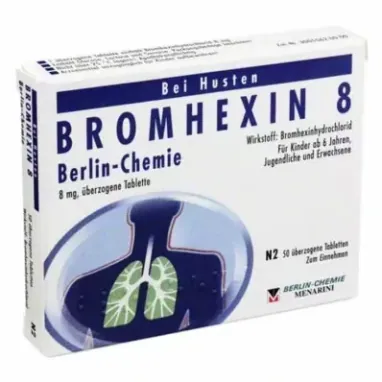
| Product | Dosage | Quantity | Price | Order |
|---|---|---|---|---|
| Bromhexine | 8mg | 200 pill | £197.78 £178.00 −10% | |
| Bromhexine | 8mg | 400 pill | £296.67 £267.00 −10% |
Why does mucus get thick?
Mucus is useful. It traps dust and bacteria, and tiny hairs called cilia sweep it steadily up the airways to be swallowed without you noticing.
That system works when the mucus has the right consistency.
During infection or inflammation the composition changes. Long chain-like molecules cross-link into a dense mesh, and the whole thing becomes thick and sticky.
Now the cilia cannot move it. It sits there, blocks small airways, and provides a comfortable environment for bacteria. You cough, and the cough just rattles.
What does it break?
Bromhexine breaks the chains holding that mesh together.
The mucus becomes less viscous and the cilia can move it again. Coughing becomes productive instead of futile.
It also appears to increase the watery component of airway secretions and to support the cilia themselves.
An interesting aside: the molecule was derived from a compound found in a plant long used for breathing problems. The traditional use was onto something, even if the reason was not understood at the time.
Why does water matter so much?
Because this is the part people skip, and it is not optional.
The medicine changes mucus structure. Water is what gives it fluidity. Thinning a mesh in someone who is dehydrated achieves much less than it should.
Drink substantialy more than usual while taking it. Steam inhalation helps, and so does keeping room air from getting too dry in winter.
No medicine for chest mucus works well in someone who is not drinking enough.
Why not take it with a cough suppressant?
Because the combination is genuinely counterproductive, and it gets made constantly by buying two products off the same shelf.
A mucolytic thins secretions so they can be coughed up. A suppressant stops you coughing.
Together you get thin secretions that cannot be cleared, pooling in the airways. Worse than either problem alone.
The rule: a productive cough wants thinning, not suppressing. A dry irritating cough with nothing to bring up may warrant suppressing, and then a mucolytic is pointless.
If you need something at night to sleep, that can sometimes be arranged — mucolytic during the day, clear gap, suppressant later. Not together.
How should you take it?
- Doses spread across the day as directed
- With or after food, which reduces stomach upset
- Plenty of fluid throughout
- Not right before bed
That last point is practical. The effect is to make you cough more productively, which is unhelpful at midnight.
What side effects turn up?
- Nausea, indigestion
- Abdominal discomfort
- Diarrhoea
- Headache
- Occasional rash
Stop and seek help for a spreading rash with blistering or involvement of the mouth and eyes. Very rare, but it needs acting on immediately.
If you have had a stomach ulcer, mention it before starting — this can irritate the stomach lining and is sometimes avoided in that situation.
When should a cough be looked at?
- Lasting more than three weeks
- Coughing up blood
- High fever or breathlessness
- Chest pain
- Unexplained weight loss
- Night sweats
- Worsening after initial improvement
- Wheezing that is new
Most coughs are viral and resolve on their own. Those are the exceptions, and a mucolytic is not the answer to any of them.
How to order without prescription
A chest infection gives no notice, which is why this tends to live in the cupboard.
You pick a strength, pick a pack size, type in where it should go, and confirm. No appointment, no form, no standing at a counter explaining yourself.
What turns up is a plain parcel. Nothing on the outside says pharmacy and nothing says what is inside. How quickly it arrives depends on where it is going.
What you pay tracks the strength and how many you buy at once. Buying more in one go brings the per-unit figure down.
What about storage once it reaches you? Dry, at room temperature, in the blister. Not the bathroom cabinet, where steam gets at the foil, and not a car in July.
Write a Review
Your rating: